
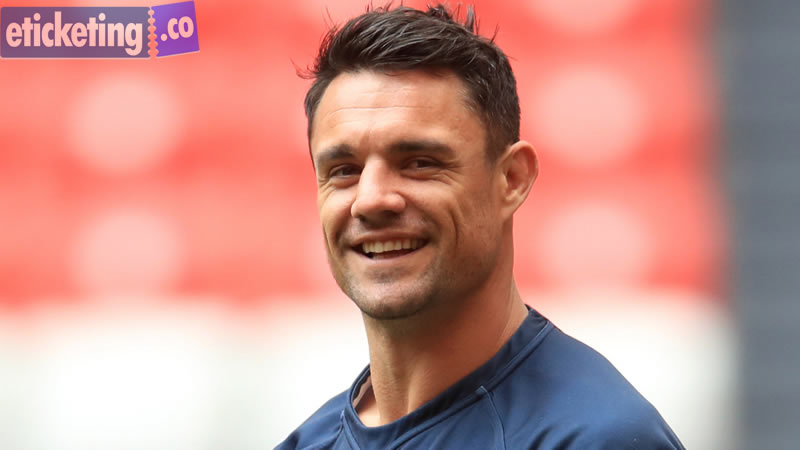
Dan Carter believes it’s far too early to lock in who will wear the All Blacks’ number 10 jersey at the Rugby World Cup 2027 in Australia. While fans and pundits are eager to predict the future, Carter’s view is more measured. He feels that although there are several strong contenders.
Don’t miss your chance to grab Rugby World Cup Tickets from eticketing.co. Witness the world’s best rugby nations compete for the Webb Ellis Cup across Australia’s iconic stadiums. Book early for the best seats and experience the thrill of world-class.

The decision will ultimately depend on who steps up and truly owns the role over the next couple of years. In recent seasons, the All Blacks have rotated their fly-half options. Damian McKenzie and Beauden Barrett have shared responsibilities in the position during the 2024 and 2025 campaigns under former head coach Scott Robertson.
Both players are versatile, capable of playing either fly-half or full-back. This has given the team flexibility, but also means neither has fully secured the number 10 shirt as their own. At the club level, McKenzie has spent time at full-back for the Chiefs in Super Rugby Pacific this year.
Although he has still featured regularly at fly-half. Barrett, on the other hand, has been used consistently at fly-half for the Blues, showing his experience and control in that role. Despite their strong credentials, the competition hasn’t stopped there.
Don’t miss your chance to grab Rugby World Cup Tickets from eticketing.co. Witness the world’s best rugby nations compete for the Webb Ellis Cup across Australia’s iconic stadiums. Book early for the best seats and experience the thrill of world-class.
Rugby World Cup: Carter Welcomes Depth but Notes Lack of Clear Leader
A new wave of talent is beginning to emerge. Young fly-half Josh Jacomb impressed early in the season with solid performances for the Chiefs. While Ruben Love has caught attention with his exciting play for the Hurricanes. Both players have quickly entered discussions as possible long-term options for the All Blacks.
Adding further depth and competition to an already crowded position. Adding another twist to the story is the return of Richie Mo’unga. Mo’unga, who was the All Blacks’ first-choice fly-half at the 2023 Rugby World Cup, has been playing in Japan for Toshiba Brave Lupus Tokyo.
He has now signed an 18-month deal with New Zealand Rugby and is set to return for the 2027 season. His comeback strengthens the pool even further and ensures that experience will be part of the selection mix.
Carter sees this situation as a positive rather than a problem. From his perspective, having multiple high-quality players competing for one of the most important positions on the field is a sign of a healthy rugby system.
However, he also pointed out that since Mo’unga’s departure, no single player has truly taken full control of the role. Instead, responsibilities have been shared, which can make it harder to build long-term consistency.
Secure your New Zealand vs Chile Tickets today at eticketing.co, the trusted destination for rugby fans worldwide. Be part of the excitement as two passionate nations face off on rugby’s biggest stage in Australia. Experience the atmosphere, the intensity, and the unforgettable moments of the Rugby World Cup live in 2027.
Rugby World Cup Final: Opportunity Knocks in Wide-Open Fly-Half Battle
Speaking about the current situation, Carter explained that the real challenge lies ahead. He believes one of these players needs to step forward and clearly establish themselves as the leading option. With several international matches and major competitions still to be played before the World Cup, there is plenty of time for that to happen.
He also highlighted how exciting this period is for New Zealand rugby. The blend of experienced players like Barrett and Mo’unga, combined with the energy and potential of younger talents like Jacomb and Love, creates a strong environment for growth and competition.

According to Carter, this kind of depth is exactly what top teams need if they want to succeed on the biggest stage. Ultimately, Carter emphasized that it’s simply too soon to predict who will start at fly-half in 2027. Form, injuries, and performance under pressure will all play a role in shaping that decision.
What matters now is which player can rise above the rest and make the position their own. For whoever does, the opportunity is huge. The number 10 jersey is one of the most influential roles in rugby, and the next player to claim it will carry both responsibility and expectation. As Carter sees it, the race is wide open, and that’s what makes it so compelling.
Rugby World Cup 2027 Tickets are now available at eticketing.co! Be part of the excitement as Australia hosts the biggest rugby tournament in the world. Secure your seats today and witness the world’s top rugby nations battle for the Webb Ellis Cup. Don’t miss this chance to experience world-class rugby live in action!
FAQS
1. Why does Dan Carter think it’s too early to decide the All Blacks’ fly-half for the Rugby World Cup 2027?
Dan Carter believes there is still plenty of rugby to be played before 2027, and the final decision will depend on form, consistency, and performance over the next few seasons.
2. Who are the main fly-half contenders for the All Blacks right now?
The main contenders include Damian McKenzie and Beauden Barrett, with emerging players like Josh Jacomb and Ruben Love also entering the conversation as long-term options.
3. How does Richie Mo’unga’s return affect the All Blacks’ selection battle?
Richie Mo’unga’s return adds major experience and depth to the squad. As a former first-choice fly-half, his presence increases competition for the number 10 jersey.
4. What makes the All Blacks’ fly-half situation so competitive?
The All Blacks have a mix of experienced stars and rising young talent, and multiple players are capable of playing both fly-half and full-back, making the position highly contested.
5. What is Dan Carter’s overall view of the fly-half race?
Carter sees the situation as a positive sign of depth in New Zealand rugby. However, he believes no player has fully taken control yet, and the race for the starting role remains wide open.